1816 Chronograph
Shortlisted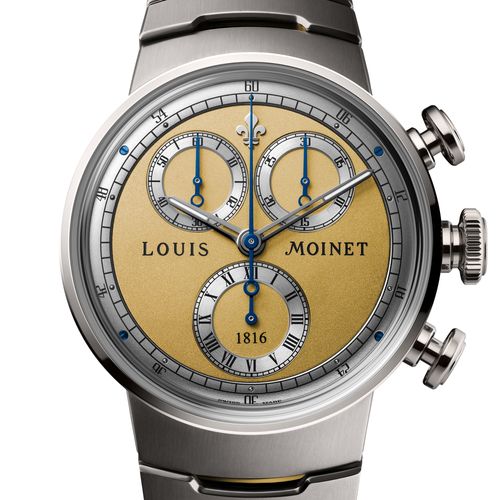
- Category
- Chronograph
- Case
- Titanium
- Movement
- Manual-winding mechanical Power reserve: 48 h, 28800 vph
- Functions
- Hours, Minutes, Seconds, Chronograph 30-minute jumping counter
- Size
- ø 40.6 mm
- Thickness
- 14.7 mm
- Water resistance
- 50 m
- Reference
- LM-151.20.30
- Price
- 31,900 CHF
Description
1816 was one of the great turning points in watchmaking history. It is the year in which the great watchmaker Louis Moinet completed the world's first chronograph.
This year, to celebrate the 210th anniversary of this invention, Les Ateliers Louis Moinet unveils a new edition of the 1816 CHRONOGRAPH in a warm champagne colour.
Reinventing heritage: The 1816 chronograph
A closer look at Louis Moinet’s new 1816 chronograph means taking a deep dive into over 200 years of history through a timepiece exhibiting a resolutely contemporary style. The DNA of the original timepiece, which with its sober, functional, and, for its time, avant-garde design, emerges in every detail. The aesthetic codes of the original model have been given a totally new interpretation but one that is always in keeping with the traditional codes of haute horlogerie.
A new edition for 210 years of the first chronograph
For this occasion, this new 1816 CHRONOGRAPH is adorned with a luminous champagne hue. This colour reflects the mechanics of the piece: an integrated, brand-new calibre engineered especially for this chronograph, which, naturally, evokes the mechanical tradition and haute horlogerie.
On the dial, this shade adds depth and warmth to the visual composition and creates a refined contrast with the blued steel hands. The rhodium-plated rings framing the counters give the design structure, which was inspired by the original timepiece, and enhance legibility.
The small seconds subdial and the 30-minute instantaneous totaliser, arranged horizontally on the top half of the dial on either side of the stationary central chronograph hand, overlook the 12-hour totaliser. The latter adopts Roman numerals for this edition, another nod to the original timepiece of 1816, while the upper sub-dials are distinguished by satin-brushed annular displays with Arabic numerals.
The entire dial is composed of twenty-three elements, including ten blackened nickel cabochons. The base and centres of the three champagne-coloured counters feature a bead-blasted finish. True to the original, the flange, which is divided into increments of six, is mounted onto the watch with four blued-steel screws.
Engraving has made it possible to precisely inscribe the dial markings, the name of the timepiece – 1816 – and the name Louis Moinet, reproduced in the typography of the original creation.
The central chronograph hand and the counters’ hands are made of heat-blued steel. The hours and minutes are indicated by Louis Moinet-style openworked hands, with tips coated in a luminescent substance.
The final touch is the fleur-de-lys logo at twelve o'clock. It pays homage to the city of Bourges, where Louis Moinet was born in 1768.
A louis moinet calibre in the finest watchmaking tradition
The challenge faced when designing the LM1816 calibre for the 1816 CHRONOGRAPH was to preserve the DNA of the original Louis Moinet chronograph while building a brand-new movement that would meet the standards of haute horlogerie. From the outset, the architecture of the movement was dictated by the unique position of the counters on the 1816 model.
The movement has 330 components, including 34 jewels, and runs at 28,800 vibrations per hour. The exhibition case back reveals the interplay of carefully finished parts, the overlapping planes and bridges, interweaving gears, and chronometric controls. The contrasts are striking: the white of the steel, the satin finish and brassy hue of the bridges, the blue of the fixing screws, and the deep red of the rubies.
Watch enthusiasts wishing to have a physical connection with their timepiece will appreciate the manual winding ritual, which ensures 48 hours of autonomy. The instantaneous minute counter, the column wheel control, and the swan-neck regulator are other elements that draw the expert eye, as they are hallmarks of authenticity, care and quality of the movement.
A distinctive case and a sculptural bracelet
The double-gadroon case, in polished and satin-finished grade 5 titanium, measures 40.6 millimetres in diameter and is composed of 51 parts. It retains its original Directoire style semi-bassine design with a smooth case middle. Two sober pushers frame the winding crown, which is decorated with a fleur-de-lys, the emblem of Bourges, Louis Moinet's birthplace. The elegant and timeless 1816 CHRONOGRAPH was made to be very comfortable on the wrist.
The champagne colour appears again on the intermediate links of the grade 5 titanium bracelet, which is integrated into the case. It highlights the distinctive U-shape of their architecture and accentuates the relief of this sculptural construction. The satin and polished finishes create a whole that is both fluid and ergonomic.
Supplied by the brand to the GPHG for its entry.