Aevum
- Category
- Mechanical Clock
- Case
- Aluminium
- Movement
- Manual-winding mechanical Power reserve: 192 h, 18000 vph
- Functions
- Hours, Minutes, Day/Night
- Size
- ø 140 mm
- Thickness
- 32 mm
- Reference
- AEVUM
- Price
- 6,000 CHF
Description
Aevum is a Latin word denoting eternity or the flow of time (as opposed to chronos, or chronological time).
The "AEVUM" project explores the perception of time in the age of constant digital interaction. It invites viewers to reject the tyranny of linear, quantitative time (time-as-a-resource) and return to a cyclical, qualitative experience of time (time-as-an-experience).
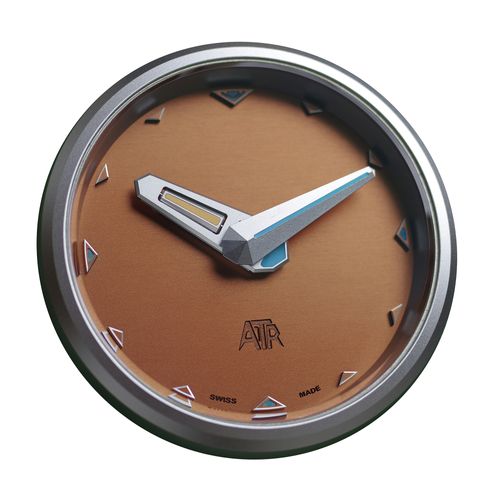
The object is a monolith of anodized aluminum with a matte surface, reminiscent of a minimalist totem. Its front face features a simple dial with no numbers, only serif markers. The dominant feature of the object is the hour hand, the mechanism of which is exposed, transforming a functional action into a performance.
The "AEVUM" concept was born from the idea of a digital detox for people living nonstop. Away from gadgets, people discover that their internal rhythms synchronize not with a clock, but with natural light.
We wanted to create an object that would be the antithesis of the smartphone. Not a device that steals attention, but an artifact that restores the ability to sense the flow of the day. This is not a watch, but a "vibe meter."
Key artistic techniques:
1. Deconstruction of timekeeping: The rejection of numbers is a gesture of rejection of the usual system of measurement. Time is no longer a value to be calculated. It is an experience, a phase, a mood.
2. Material as a statement: Aluminum, the material of aviation and digital devices, symbolizes sterile, "technogenic" time. Its cold aesthetic contrasts with the "warm," poetic idea of reversing phases. It is a metaphor for the search for the human in the heart of the machine.
3. The Hand as a Mediator: The four sides of the hand are not just colors, but color collages made from fragments of digital photographs (pixelated skies, city lights, textures). Thus, the hand becomes an optical instrument through which we examine the "remnants" of real time.
• One side – the colors of the morning: from pearlescent white to orange (dawn).
• The second side – the colors of the day: from bright yellow (midday) to white (afternoon).
• The third side – the colors of the evening: from gold to violet (sunset).
• The fourth side – the colors of the night: starlight (night).
We want every glance at the watch to remind us not of time passing, but of the exact moment we are living right now. That's the real magic.
Supplied by the brand to the GPHG for its entry.