Cadence Miroir
- Category
- Petite Aiguille
- Case
- Steel
- Movement
- Manual-winding mechanical Power reserve: 96 h, 21600 vph
- Functions
- Hours, Minutes, Seconds, Power reserve indicator
- Size
- ø 39 mm
- Thickness
- 10.75 mm
- Water resistance
- 30 m
- Reference
- CH_CM26-01
- Price
- 9,755 CHF
Description
The Cadence Miroir is built around the MSE211 calibre by Schwarz Etienne, selected for its twin mainspring barrels mounted in parallel. This architecture ensures smooth winding, stable torque delivery, and balanced energy transmission throughout the power reserve. By distributing force more evenly across the gear train, the twin-barrel construction reduces mechanical stress within the movement and contributes to enhanced chronometric stability.
Precision timekeeping lies at the heart of the Cadence Miroir. Its conceptual inspiration reaches back to the great maritime chronometers developed during the search to solve the “Longitude Problem,” most famously addressed through the work of John Harrison. In tribute to that pursuit of navigational precision, Feu de Sable reinterpreted the traditional power reserve as a “winding indicator.”
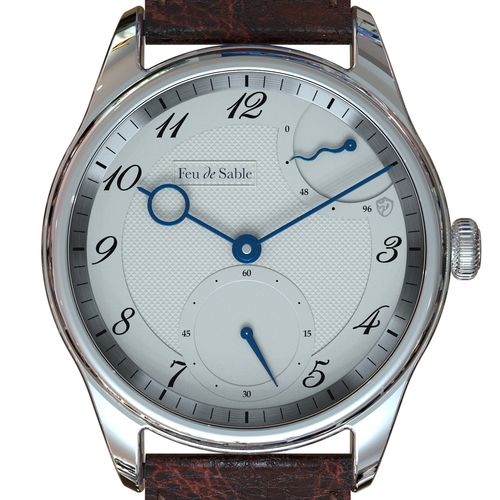
Rather than indicating remaining autonomy, the Cadence Miroir measures the number of hours elapsed since the watch was last wound, progressing from “0” to “96.” Positioned beside the final marker is the dragon of the Feu de Sable emblem — a discreet reference to the uncertainties of maritime navigation and the importance of precision timekeeping at sea.
The hands were conceived in an observatory-inspired style, referencing the great observatories once dedicated to measuring chronometric performance. The thermally blued “pomme” hour hand is paired with a slender baton minute hand to reinforce clarity and balance. An oversized ring framing the eccentric seconds emphasizes the continuous motion of the Dauphine seconds hand — a subtle but constant reminder of the passage of time. Completing the composition is the “dragon’s tongue” indicator hand sweeping across the winding scale, advancing steadily toward the 96-hour mark.
The typography of the Cadence Miroir derives from Gerard Mercator and Jodocus Hondius’s Guineae Nova Descriptio, published in Amsterdam in 1635. The hand-lettered forms found on the original map inspired the glossy black numerals used throughout the hour chapter ring. Within this ring lies a Clous de Paris guilloché pattern that softens reflections across the dial surface while visually defining the space occupied by the winding indicator and eccentric seconds display. Along the dial’s outer edge, the minute track features circular brushing with a silvered upper surface and contrasting black indexes, creating both depth and legibility.
At its core, the Cadence Miroir reflects Feu de Sable’s philosophy that precision and poetry are not opposing ideals, but complementary expressions of horology itself — where technical discipline, historical memory, and symbolic design converge within a single instrument of time.
Supplied by the brand to the GPHG for its entry.