Constant Force Tourbillon 11
Shortlisted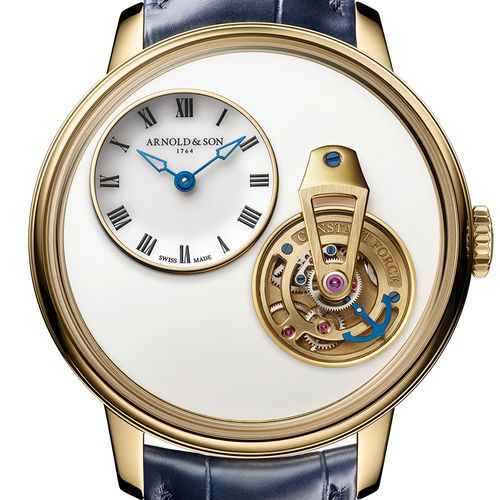
- Category
- Tourbillon
- Case
- Yellow gold
- Movement
- Manual-winding mechanical Power reserve: 100 h, 21600 vph
- Functions
- Hours, Minutes, Tourbillon, Special escapement Constant force escapement
- Size
- ø 41.5 mm
- Thickness
- 13.7 mm
- Water resistance
- 30 m
- Reference
- 1FCBJ.E01A.C246J
- Price
- 129,800 CHF
Description
The 41.5 mm diameter Constant Force Tourbillon 11 watch in 18-carat yellow gold, released by Arnold & Son as a limited edition of 11, is driven by a hand-wound mechanical movement. Equipped with two barrels to give a 100-hour power reserve, this timepiece was entirely developed and built at the manufacture in La Chaux-de-Fonds. It is fitted with a constant force mechanism visible on the enamel dial and is regulated by a tourbillon that can be seen on the back. The architecture of this calibre is inspired by that of the timekeeping instrument driven by the first tourbillon created by Abraham-Louis Breguet in 1808, based on a chronometer movement designed by John Arnold. This first tourbillon regulator, now in the British Museum, was given to John Roger Arnold by the Paris-based watchmaker in honour of his scientific collaboration and friendship with his father. The Constant Force Tourbillon 11 timepiece, designed to mark the end of the 260th anniversary celebrations of John Arnold’s legacy, pays tribute to the watchmaker’s ingenuity and his close association with Abraham-Louis Breguet.
The greatest watchmakers of the Age of Enlightenment often knew each other. Some of them exchanged views and appreciated each other despite language barriers and political obstacles. And this was the case with John Arnold and Abraham-Louis Breguet. These two watchmakers, undoubtedly the most productive of the second half of the 18th century, forged a friendship that nothing could shake, not even the throes of war between the two countries or the French Revolution. Aware of their respective talents, during Abraham-Louis Breguet’s frequent trips to London between 1789 and 1791, they shared their views and knowledge of the principles of timekeeping, furthering the science of timekeeping, which in their eyes definitely knew no frontiers.
When context is everything
While John Arnold was captivated by the understated design of Abraham-Louis Breguet’s watches and his understanding of complex kinematics, Abraham-Louis Breguet was fascinated by his English friend’s ability to invent simple mechanisms that could be mass-produced and approached a chronometric precision that no other watchmaker of the time could hope to achieve. During their exchanges, which included sending their respective sons to train with the other, these two geniuses were able to work out the best way of eliminating the running errors of watch balances.
The English watchmaker concentrated on optimising his detent escapement and developing balances, such as special springs, so as to offer instruments capable of satisfying his proto-industrial approach to chronometer construction – especially as the Admiralty asked him to produce them in ever greater quantities and at ever lower prices.
Meanwhile, Abraham-Louis Breguet, inspired by his conversations with his English friend on the principles of high chronometry, continued to work on developing the tourbillon during his exile in Switzerland from 1792. On his return to Paris in 1795, he wrote about the development of a rotating carriage in a letter. Then, two years after John Arnold’s death in 1799, he patented this mechanism under the name ‘tourbillon’ in Paris on 26 June 1801, i.e. 7 Messidor Year IX, according to the French Republican calendar still in effect at the time.
To honour the memory of his friend and remember the research they had carried out together, he based his first tourbillon regulator on the movement of John Arnold’s marine chronometer no. 11. He screwed an engraved silver plate onto the main bridge with the following dedication: “The first tourbillon regulator by Breguet incorporated in one of the first works of Arnold. Breguet's homage to the revered memory of Arnold. Presented to his son in the year 1808.” This timekeeping instrument, now in the British Museum, was given to John Roger Arnold, who succeeded his father as head of the workshop and London boutique.
A chronometer designed to tell a story
As a tribute to their work and in memory of the friendship between these two watchmaking geniuses during the Age of Enlightenment, Arnold & Son has chosen to give this Constant Force Tourbillon 11 watch a 41.5 mm diameter 18-carat yellow gold case with a classic design. The yellow hue of this precious metal was chosen because it was often used by John Arnold for prestigious pocket watches at the time. It is in perfect harmony with the openworked bridge of the constant force mechanism, which is also made of 18-carat yellow gold. The timepiece’s curved case middle helps to reduce its profile. The front features a thin bezel set with a slightly domed sapphire crystal with an anti-reflective coating on both sides. On the reverse, it has an open case back in yellow gold with an identical sapphire crystal, revealing the manual winding manufacture calibre with the reference A&S5219. Water-resistant up to a pressure of 3 bar (30 metres or 100 feet), the watch is worn on an alligator leather strap fastened around the wrist with a classic pin buckle in 18-carat yellow gold bearing the Arnold & Son monogram.
A precious and captivating dial
For the Constant Force Tourbillon 11 timepiece, Arnold & Son chose a white Grand Feu enamel dial to recall the dials of the ship’s chronometers that John Arnold offered to English naval officers in his London boutique. This disc was individually produced by a specialist artisan on an 18-carat yellow gold base. White enamel is obtained by melting powdered materials in a kiln heated to just over 800°C. After firing the enamel several times to achieve the required thickness, the surface is lapped to make it smooth and even. Then, as long as the material has not cracked and there are no imperfections that would spoil the white colour, a translucent enamel is applied and the disc is fired one last time. This gives it depth and transparency, bringing out the full magic of the enamel, whose hue is permanent and is called ‘Grand Feu’ (great fire) because it is vitrified by melting. Openings are then made in this delicate and precious disc to accommodate the constant force mechanism and white opal subdial – a true signature of the House. Here, for the first time at Arnold & Son, this fine stone has been recessed to give it a stronger visual presence and an angle that enhances the readability of the black transfer Roman numerals.
A calibre worthy of the master of chronometers
The A&S5219 movement was specially developed by the Manufacture’s engineers and watchmakers to the specifications of the Constant Force Tourbillon 11 watch. To remain as faithful to the original movement as possible, this calibre is hand-wound. But while inspired by the past, it remains thoroughly contemporary. It is equipped with two identical barrels mounted in series, giving a 100-hour power reserve. These barrels alternate in driving the mechanism, the second being activated when the torque of the first falls below optimum output.
A constant force mechanism […]
Supplied by the brand to the GPHG for its entry.