DC12 Maverik
- Category
- Mechanical Exception
- Case
- Titanium
- Movement
- Manual-winding mechanical Power reserve: 96 h, 21600 vph
- Functions
- Hours, Minutes, Seconds, Special escapement Double balance, central differential
- Size
- ø 39.5 mm
- Thickness
- 11.7 mm
- Water resistance
- 50 m
- Reference
- DC12 MaveriK
- Price
- 105,938 CHF
Description
DC12 MaveriK
The DC12 MaveriK is the result of seventeen years of development. Its all-titanium C30 caliber is based on a unique regulating mechanism that ensures exceptional chronometric performance.
Two balance wheels oscillate independently, each with its own rate deviation. They are neither synchronized nor in resonance, and this is the central feature of the complication. A planetary differential with a flying satellite connects them and calculates the average of their rates in real time. This average yields a level of precision that a single balance wheel cannot achieve.
This approach was pioneered in the 1930s at the École Technique de la Vallée de Joux, in a pocket watch. In 1996, Philippe Dufour revived this concept and adapted it to the wristwatch format with the Duality. These timepieces achieve extreme precision and remain highly demanding to manufacture.
The difficulty lies in the energy supply—or rather, its scarcity within the seconds train. Both balance wheels draw from the same source, where energy is most difficult to distribute; they can interfere with each other, even to the point of stopping. The traditional solution is to move the differential away from the seconds train and place it on the center wheel, where it completes a revolution in about four minutes: it then averages the balance wheels’ rates only over this cycle, and most of the chronometric benefit is lost.
David spent seventeen years—and three prototypes—searching for a solution to this problem. He completely reimagined the architecture to overcome it: the differential remains on the seconds train, mounted on a spiral spring shock absorber. The satellite does not constrain the balance wheels; it accompanies them. It absorbs variations in force and distributes energy according to each balance wheel’s needs.
This spring makes the system extremely smooth, with two consequences. The first is precision: as a point of reference, the COSC’s accepted rate tolerance ranges from −4 to +6 s/day, whereas the DC12 MaveriK is measured in-house at between 0 and +2 s/day. The second consequence is energy efficiency. Two mainsprings power the movement, and despite its two balance wheels, the system’s low friction extends the power reserve to over 110 hours, 96 of which are chronometric.
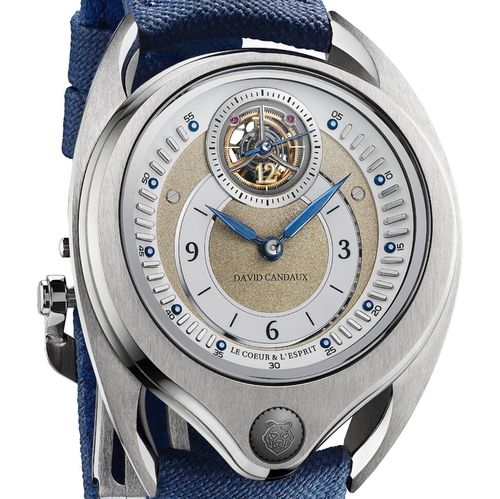
All of David Candaux’s watches start with the crown. The “Magic Crown,” at 6 o’clock, is retractable and composed of 31 components; it retracts into the case once the time has been set. Placing it at 6 o’clock rather than 3 o’clock frees up the right side of the case and dictates the entire ergonomic design. The case is curved to hug the wrist, and everything—right down to the arched sapphire crystal—follows this curve. At 39.5 millimeters, it is the brand’s smallest watch. It is water-resistant to 50 meters.
At 12 o’clock, an opening in the dial reveals the transparent differential gear. Three-dimensional and suspended, it drives the small seconds hand. At the center of the dial, the hour and minute disc is made of white opal, rimmed with mirror-polished edges. The diamond-cut white gold indexes follow the curve of the dial; the markers are spaced at five-minute intervals along the outer edge. The flame-blued hands catch the light.
Through a wide aperture, the case back reveals the movement’s two beating hearts, crafted from Grade 5 titanium. Two elongated bridges, stretched like arches and adorned with straight graining inspired by historic models, support the balance wheels; a central bridge, hand-finished with a snow-grain pattern, asserts its presence with understated elegance. Polished internal chamfers, brushed sides: every finish meets the exacting standards of traditional watchmaking in the Vallée de Joux.
David Candaux is an independent watchmaker based in Solliat, in the Vallée de Joux, where watchmaking has been practiced since 1740. He founded his brand in 2017, after more than twenty years of developing movements for some of the most demanding watchmakers. As a watchmaker, manufacturer, and engineer, he designs and develops his watches, which are crafted using traditional methods with his small team in the workshop. He is the only watchmaker to construct each of his movements entirely from titanium.
Supplied by the brand to the GPHG for its entry.