Insight Micro-Rotor Squelette Manufacture-Only Carbonium® Edition
Shortlisted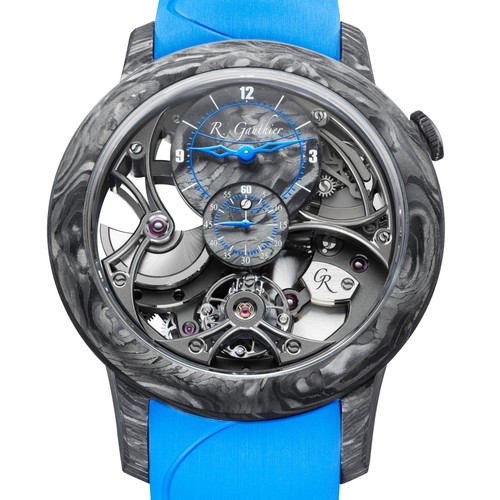
- Category
- Men's
- Case
- Carbonium®
- Movement
- Self-winding mechanical Power reserve: 80 h, 28800 vph Skeleton movement
- Functions
- Hours, Minutes, Seconds
- Size
- ø 42 mm
- Thickness
- 12.9 mm
- Water resistance
- 50 m
- Reference
- MON00385
- Price
- 166,000 CHF
Description
INSIGHT MICRO-ROTOR SQUELETTE MANUFACTURE-ONLY CARBONIUM® EDITION
With a stunning, skeletonised, in-house movement featuring superlatively hand-finished mainplate and bridges in ultra-light, natural titanium, housed in an eye-catching Carbonium® case
This year marks the 15th anniversary of Romain Gauthier. It is fitting, then, that the Swiss watchmaker’s latest creation, Insight Micro-Rotor Squelette, calls on an area of craftsmanship for which he and his team have been heralded since the birth of the brand in 2005: hand-finishing.
By opening up and stripping down his high-end, time-only automatic calibre, Romain has created a truly contemporary skeleton watch that is a technical and artistic tour de force. Not only do the skeletonised, ultra-light natural titanium bridges and mainplate help to reveal the mesmerising mechanics of the in-house movement, they also provide the perfect platform for the Romain Gauthier anglage specialists to demonstrate their immense skills.
For each Insight Micro-Rotor Squelette movement features as many as 250 hours devoted to anglage alone, that’s to say the bevelling, softening, smoothing and polishing by hand of the bridges and mainplate, in an extraordinary demonstration of watchmaking artistry.
For the 2020 GPHG, Romain Gauthier is entering the Insight Micro-Rotor Squelette Manufacture-Only Carbonium® Edition. Available exclusively via Manufacture Romain Gauthier, it features a 42mm-case, crown, dial and buckle made out of Carbonium®, a cutting-edge carbon composite sourced from aerospace-grade fibres that is light, mechanically resistant and catches the eye with its dynamic veining.
INSIGHT MICRO-ROTOR SQUELETTE MANUFACTURE-ONLY CARBONIUM® EDITION IN DETAIL
Skeletonising Insight Micro-Rotor
For either technical or aesthetic reasons, not every calibre lends itself to skeletonisation, and Romain Gauthier’s in-house movements are no different. “If you skeletonised my first movement Prestige HM/HMS, there would be sizeable voids leaving little to see except the hair on your wrist, and that’s not ideal,” says Romain. “The open architecture of my Logical One means that if you opened it up even more, you wouldn’t necessarily be able to view more of the mechanics than what you can already see. However, my Insight Micro-Rotor jumps out as a natural fit for skeletonisation.”
Insight Micro-Rotor is Romain Gauthier’s high-end, automatic timepiece of which the hour, minute and small second indications are powered by an in-house calibre boasting bidirectional micro-rotor made from 22k solid gold. Visible dial side and through the display back, this oscillating weight turns smoothly between two bridges, each fitted with a friction-minimising, wear-resistant ruby bearing. In whichever direction the micro-rotor swings, it winds a serially operating double mainspring barrel offering 80 hours of power at full wind. For Romain, the architecture of the arcing bridges, the position of the balance and micro-rotor, and the layout of the gears and barrels meant skeletonising this movement would really add something.
He says: “As I worked on the design and explored potential executions, it became clear that skeletonising Insight Micro-Rotor would not leave awkward gaps, but would instead reveal previously hidden details and create new ones, making this movement even more expressive.”
Material decisions: Making the mainplate and bridges in ultra-light, natural titanium
Romain’s design for opening up the Insight Micro-Rotor entailed skeletonising the mainplate and eight bridges that, until now, have been made in solid brass. At the thicknesses he envisaged, going as thin as 0.7mm, skeletonised brass bridges wouldn’t have necessarily held up. Grade 5 titanium, however, offered the requisite strength and a lightness that could reduce the overall weight of the movement to 15.95g, the ability to look good naturally without the need for galvanic deposition, and the ability to be hand-polished. All the same, machining titanium has its challenges.
“Titanium takes longer than brass to machine the material into the required shape. Progress is slower and more incremental, with more steps required for each piece,” says Romain. “It wears down tools and can break them more easily. There is always a risk of fire, so you must avoid unmonitored machining during the night. And it also tests the machine operators’ ability to work within +/- 2-micron tolerances because if any holes are a fraction too small, the jewels could break when the watchmakers drive them in.”
Off-the-scale hand-finishing drawing on 15 years of savoir-faire
If machining the titanium mainplate and bridges of Insight Micro-Rotor Squelette has its challenges, they pale in comparison to the challenges of hand-finishing them. For this skeletonised movement calls on a particular savoir-faire for which Romain and his team have garnered plenty of plaudits since the brand was founded in 2005: anglage, or the art of bevelling, softening, smoothing and polishing components by hand.
Put simply, anglage beautifies the component by creating a polished bevel between its surface and its flanks, one which catches the light and the eye angleuse creates a bevel using a steel file, then softens and smooths the material, first with degussit stone then using a series of buffs with emery-paper tip gradually going from a coarser to a finer grain, before polishing the bevel using the. The angleur or woody stem of the locally-growing gentian plant with diamond paste. It requires skill, experience and patience, and even relatively simply-shaped bridges made in brass can each take tens of hours to bevel, soften, smooth and polish by hand.
As you can imagine, the skeletonised mainplate and bridges of the Insight Micro-Rotor Squelette tested the talents of the Romain Gauthier anglage team on an entirely new level. One thing was the complexity of the shapes created by the skeletonisation, featuring o fewer than 156 internal angles that make it tricky for these artisans to access with their handheld tools, while limiting the scope of movement that their hands can make. Another thing was the way in which the titanium behaves.
“In all my 17 years as an angleuse, I have never worked on a movement consisting of so much titanium,“ says Sylvie Devaux, Head of Anglage at Manufacture Romain Gauthier. “I’ve worked on brass, steel, gold and German silver components and am even used to working on the titanium constant-force bridge of Romain’s Logical One, which takes a good 20 hours to finish by hand. But Insight Micro-Rotor Squelette is another proposition for me and my team.
“The same properties that make titanium a challenge to machine also make it extremely difficult to hand-finish. Each of the bevelling, softening, smoothing and polishing stages take far longer than working with brass. You have to repeat steps, sometimes twice. Titanium tends to stick to our anglage tools, and we have to keep trimming the ends of the buffs and gentian so they stay effective. You also sometimes come across micro-grains in the titanium that detach, leaving tiny spots. The only solution is to go back over the angle all again.”
Indeed, it takes one Romain Gauthier anglage specialist no fewer than 250 hours to bevel, soften, smooth and polish by hand the natural titanium mainplate and eight bridges needed for one Insight Micro-Rotor Squelette.
And that’s not even counting the time it takes Sylvie and her team to carry out other decorative techniques applied by hand to these components, such as polishing the screw and jewel countersinks using an ebony spindle, satin-finishing the flanks and hand-frosting the flat surfaces. In fact, when you add up all the hours devoted to decorating the entire movement by hand or by hand-operated tools – including anglage, hand-frosting, polishing countersinks, circular graining, straight graining and snailing – it comes to over 350 hours of work! […]
Supplied by the brand to the GPHG for its entry.