Minute Repeater Flying Bridges
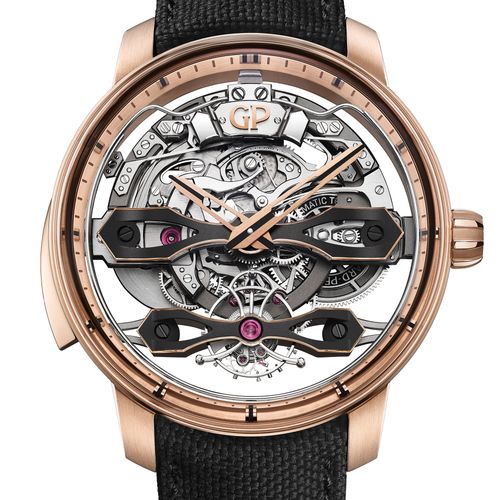
- Category
- Mechanical Exception
- Case
- Pink gold
- Movement
- Self-winding mechanical Power reserve: 60 h, 21600 vph Skeleton movement
- Functions
- Hours, Minutes, Seconds, Tourbillon, Minute Repeater
- Size
- ø 46 mm
- Thickness
- 17.90 mm
- Water resistance
- 30 m
- Reference
- 99840-52-2013-5CC
- Price
- 530,000 CHF
Description
Minute Repeater Flying Bridges
As the third benchmark calibre unveiled in less than six months, the GP9530 vividly illustrates Girard-Perregaux's dynamic approach to Haute Horlogerie. Entirely designed, developed and assembled in-house, it pays tribute to the minute repeater, a complication emblematic of the brand since the 1820s.
This 475-part openworked calibre combines a minute repeater, a tourbillon and a new self-winding system. Its assembly and decoration require nearly 440 hours of work.
Offering a fresh expression of Girard-Perregaux's expertise in the field of chiming watches, Calibre GP9530 stems from an alliance between expertise born in the late 18th century and 21st-century engineering. The Minute Repeater Flying Bridges characterises the vision of avant-garde Haute Horlogerie and marks a new era in the history of Girard-Perregaux minute repeaters.
Developed to enhance the acoustic experience through a series of technical and aesthetic choices exalting the purity of sound, its diffusion and resonance, this new calibre blends design and function, highlighting the beauty of each component within a perfectly symmetrical structure.
Experts in the design of complex calibres, Girard-Perregaux's master-watchmakers have achieved a technical feat by combining two grand complications and a new self-winding system featuring a micro-rotor in a movement measuring 43.55 mm in diameter and 10.75 mm thick.
Skilfully openworked to ensure maximum transparency, Calibre GP9530 offers a modern interpretation of the Three Bridges architecture, the brand's iconic signature since the mid-1800s. In this contemporary version, the historical aesthetic has been reinterpreted with the third bridge positioned at the rear of the movement.
The bridges’ arrow-shaped ends represent the DNA of a Manufacture firmly focused on the future.
Chiming watches embedded in the Girard-Perregaux DNA
“Listening” to the time is an ancient custom. At the end of the 18th century, the bell attached to the back of pocket watches to chime the hours and quarters was replaced by a new device consisting of a gong wrapped around the movement and a hammer – the principle upon which today’s minute repeaters are still based.
A pioneering watchmaker curious to explore the possibilities offered by the inventions of his era, Jean-François Bautte (1772-1837) began working from an early stage on the development of chiming mechanisms that repeated the hours and quarters on demand. The precocious and remarkably talented young Geneva watchmaker also trained in engraving, jewellery and goldsmithing.
Passionate about mechanics and an artist at heart, he was fascinated by the exploration of automatons, skilfully combining watchmaking, jewellery and artistic crafts to create music boxes, singing birds and other fabulous objects that enchanted a wealthy and international clientele. Bautte was not only one of the most renowned watchmakers of the era, but also a visionary entrepreneur. At a time when the custom was to outsource work using the établissage system involving separate artisans working on various parts of the watch, he chose to bring all the watchmaking trades under one roof to control the entire production process – from design to assembly and decoration, thus inventing the concept of an integrated Manufacture.
Building on this heritage and faithful to this vision, Manufacture Girard-Perregaux has continued to perfect and refine its creations with the development of minute repeaters and chimes (cathedral and carillon) combining different tones. The level of mastery achieved in this field by Constant Girard-Perregaux and his son Constant Girard-Gallet during the 19th century gave rise to alarm watches, Grande Sonnerie models and a number of timepieces combining minute repeaters with complications such as chronographs or complete calendars with moon-phase displays.
In 1996, Girard-Perregaux combined a minute repeater and tourbillon for the first time in a wristwatch, a grand complication that has also been part of the brand's DNA since its inception. The miniaturised 20th-century minute repeater could now be worn on the wrist in a water-resistant case, whose small size called for new developments in acoustics. Equipped with a Westminster chime reproducing the carillon’s four-note melody (G, D, E and C), the Opera I and II collections require expertise and know-how possessed by only the great movement Manufactures. The extremely complex movement must be assembled, tested, adjusted and reassembled multiple times without damaging the components.
For more than two centuries, Girard-Perregaux has been perfecting this complication to usher it into the modern era: technically by combining it with a flying tourbillon, as well as aesthetically through its “Flying Bridges” concept and its openworked Three Bridges calibre.
Each timepiece represents the encounter between centuries-old heritage and contemporary engineering.
A concentrated blend of innovations dedicated to sound
Acoustic performance lies at the heart of the development of Calibre GP9530, a masterpiece of watchmaking architecture combining a chiming mechanism, a tourbillon and a micro-rotor winding mechanism within an openworked movement.
The quest for a perfectly clear, vibrant sound entailed developments marking a new stage in the history of chiming watches within the Manufacture. Every technical choice was made with the aim of optimising the final quality of the chiming mechanism.
Its development was guided by a determination to achieve pure tone, effective vibration propagation and optimal case acoustics while eliminating unwanted noise.
The plate and bridges are made of titanium, a light, rigid material that facilitates the propagation of vibrations throughout the movement. The mainplate itself has been secured to the case to ensure that these vibrations are transmitted – without any loss – from the movement to the rose gold case of the Flying Bridges Minute Repeater. A domed sapphire crystal on either side of the case amplifies the crystal-clear melody produced by the hammers striking the gongs on the dial side. To avoid any noise or interference that might be detrimental to sound purity, the gongs and the gong stud are made from a single piece of metal and the centrifugal strikework regulator has been moved to the back of the movement. Finally, the jewel-fitted white gold micro-rotor of the new self-winding system oscillates in complete silence.
The openworking of the calibre is both an aesthetic and functional choice. While revealing the movement’s delicate inner workings, its airy structure also ensures optimal resonance. The sound is almost entirely unimpeded as it reverberates inside the case.
The case has been equipped with an innovative arrow-shaped slide-piece system seamlessly integrated into the new monobloc case-middle. This technical innovation results in enhanced reliability and unique water resistance to 30 metres.
When heritage meets the here and now
A Manufacture known for its movement-making excellence, Girard-Perregaux has also established itself in the realm of design since the 19th century. The revolutionary, now iconic, La Esmeralda and its Three Gold Bridges revealed and magnified functional elements to create an unmistakable visual signature in the mid-1800s. Since then, the conceptualisation of a movement and its aesthetics have formed a cohesive whole within which form and function are inseparable. The balance, symmetry and refinement devoted to the decoration of each component are part of a heritage that has been passed down throughout the history of Girard-Perregaux.
Crafted in pink gold, the three stylised Flying Bridges (the third is at the rear of the movement) support an exceptionally elegant, airy structure in which the chiming mechanism and tourbillon appear to be levitating. The same demand for balance prevails on the caseback, where the new self-winding system mirrors the barrel to ensure perfect symmetry […]
Supplied by the brand to the GPHG for its entry.