Spaceview 314 Titanium
- Category
- Petite Aiguille
- Case
- Titanium
- Movement
- Electromechanical 1296000 vph Skeleton movement
- Functions
- Hours, Minutes, Seconds
- Size
- ø 39 mm
- Thickness
- 13.25 mm
- Water resistance
- 50 m
- Reference
- 26A213
- Price
- 4,915 CHF
Description
The Accutron did not tick. It hummed. In 1960 the world filed that under electronic, because electronic was the language of the future. We have the advantage of distance now. From here, sixty-five years on and in a watch culture that prizes mechanical craft above almost anything, the tuning fork reads as what it always was: not electronic, but mechanical. After the escapement, the tuning fork was the only other mechanical force ever to keep time on the human wrist. The power was electronic. The time itself was kept by mechanical force.
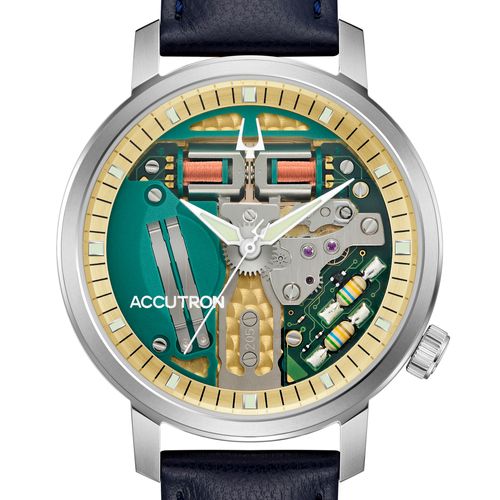
What keeps the time is a piece of metal that wants to vibrate at exactly 360 cycles per second, and would whether anyone listened or not. The frequency is not produced by the electronics. It is held by the fork itself, by mass and geometry, by physics. The coils only feed the motion. That vibration is transmitted to a four-hundred-tooth index wheel through two small components: a pawl and a driving jewel. In the original 1960 movement these were ruby, attached with lacquer, and at 360 Hz they generated enough heat to risk detaching from the fork itself. In the Y230 they are silicium, which does not heat in the same way. The result is the watch’s signature: a seconds hand that does not step but glides, continuously, across the dial. Accutron opened the case to show the mechanism at work, and the Spaceview was born, a watch that wears its own engineering as its face.
The history is not in dispute. The original was the first wristwatch ever sold with a guaranteed accuracy, two seconds per day, when the finest mechanical chronometers were rated to roughly six. American railroads certified it. NASA placed it in the cockpits of Mercury, Gemini, and Apollo, and a modified movement on the surface of the moon inside the ALSEP package. For nearly a decade it was the most accurate wristwatch in the world. Then quartz arrived, cheaper, and the tuning fork went quiet, remembered as a curiosity of the electronic age rather than the mechanical milestone it was.
The Spaceview 314 corrects the record.
Supplied by the brand to the GPHG for its entry.