Spaceview Evolution Forged Carbon
- Category
- Challenge
- Case
- Steel
- Movement
- Electrostatic
- Functions
- Hours, Minutes, Seconds
- Size
- ø 43.5 mm
- Thickness
- 16.17 mm
- Water resistance
- 50 m
- Reference
- 26A215
- Price
- 3,567 CHF
Description
In 1745, in a small physics laboratory in Erfurt, the first electrostatic motor was demonstrated. It used electric charge, rather than magnetism, to produce motion. For nearly three centuries the principle was understood and considered impractical for anything small. The forces were too delicate. The materials were too crude. The science worked. The engineering did not.
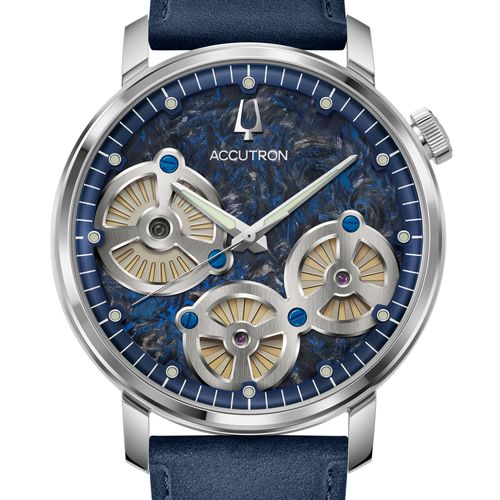
The Accutron Spaceview Evolution houses the NS30, the first electrostatic movement in any wristwatch. Two turbines, spinning at high speed between fixed electrodes, generate electric charge from any motion or force the watch encounters, worn or at rest. That charge is stored, and it drives the world’s first electrostatic motor in a wristwatch, which drives the fluid sweep of the second hand. A step motor handles the hour and minute hands. The accuracy is rated at five seconds per month.
The result is the gliding second hand that has been the visual signature of Accutron since 1960. Once driven by a tuning fork. Now driven by electric charge. Two generations of unconventional engineering, arriving at the same place.
What was impractical for two hundred and eighty years became, with a great deal of patience, the watch on your wrist this year.
The dial is forged carbon, a material in which carbon-fiber strands are compressed under heat and pressure into shapes that cannot be controlled or repeated. Every dial is unique because the manufacturing process makes uniformity impossible. The closed dial is cut with apertures so the wearer can see the turbines turn, continuing a brand language that goes back more than sixty years: an Accutron Spaceview is a watch designed to show you how it works.
Underneath, the NS30 generates and stores its own energy continuously. No battery. No mainspring. The timekeeping is regulated by a quartz crystal, as in any precision electronic watch. What is unconventional is the motor architecture. The hour and minute hands are driven by a conventional magnetic stepper motor. The second hand is driven by something no other wristwatch has ever used: an electrostatic motor, powered by the accumulation and dispersion of electrostatic charge generated by the turbines and harvested from the electrostatic interactions inside the system itself, whether worn or at rest. The world’s first appears precisely where it produces the watch’s most recognizable feature: the continuous, gliding sweep of the seconds hand.
Supplied by the brand to the GPHG for its entry.