Split Second Chronograph Worldtime
Shortlisted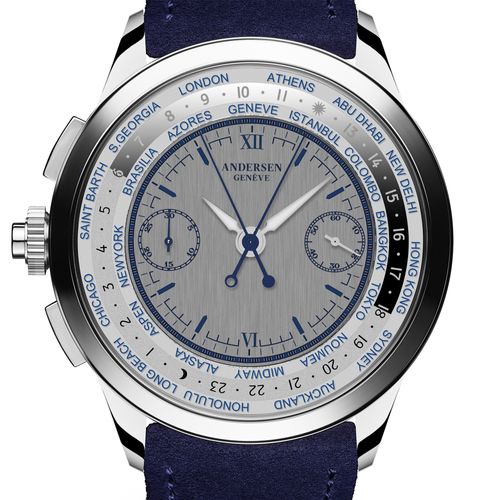
- Category
- Chronograph
- Case
- Platinum
- Movement
- Manual-winding mechanical Power reserve: 50 h, 18000 vph
- Functions
- Hours, Minutes, Worldtime, Split Second Chronograph
- Size
- ø 38.80 mm
- Thickness
- 11.95 mm
- Water resistance
- 30 m
- Reference
- 631
- Price
- 184,000 CHF
Description
SPLIT-SECONDS WORLDTIME
ANDERSEN Genève presents the world’s first ever Split-Seconds Worldtimer – an exquisitely-executed, first-time fusion of two of watchmaking’s most sophisticated complications: the ‘rattrapante’ (or split-seconds) chronograph and the worldtimer.
Housed in a 38.8mm case of 950 platinum, the watch combines a vintage Venus 179 split-seconds chronograph movement – a famous calibre used historically by brands including Breitling, Record, Excelsior Park and Ulysse Nardin – with ANDERSEN Genève’s brand new ultra-thin, finely engineered worldtime module.
The pairing of these two complications is unprecedented. The concept was devised by founder Svend Andersen and Pierre-Alexandre Aeschlimann in 2017, and has been prototyped and refined over the last two years with the help of in house watchmakers. Innovative design choices, exceptional horological skill and immaculate haute-horlogerie hand-finishing techniques make this among the most accomplished and sophisticated watches to emerge from the brand’s Geneva and La Chaux-de-Fonds Ateliers.
CLARITY, ARTISTRY, COMPLEXITY
The case, crafted using traditional techniques and without the use of CNC machines, is made from 950 platinum, with a slim, three-part construction and soft curved lugs. Measuring 38.8mm across and 11.95mm in height, it is expertly hand-polished to a mirror-finish in ANDERSEN Genève ’s traditional case-making Atelier in La Chaux-de-Fonds.
Unusually, in a quirky detail that reflects requests from collectors while echoing certain unique pieces made by ANDERSEN Genève in the past, the chronograph pushers and crown are positioned on the left side of the case. While not intended specifically for left-handed wear, this arrangement allows the chronograph to be operated with the thumb, and provides a point of difference from standard layouts. A second crown, recessed into the case contours on the right flank, is used to adjust the city disc.
At the heart of the display is a central dial for the chronograph display, with subdials at 3 and 9 o’clock, showing a 30-minute chronograph counter and running seconds respectively. Surrounding this are the elements for the worldtime function – a rotating 24-hours ring, and an adjustable city disc in sapphire to denote the 24 time zones.
For ANDERSEN Genève ’s team of watchmakers it was essential to prioritise readability without compromising the discreet, classical proportions of the watch. To achieve this, the Split-Seconds Worldtime introduces an innovative variation on the classical worldtime layout.
Rather than the usual arrangement of a 24-hour ring encircled by a peripheral city ring, the two are combined, with the 24-hour ring seemingly integrated between the outer and inner tiers of the city disc. In reality, the city names are printed on the underside of a sapphire disc, just 0.5mm thick, which sits directly above the 24-hour ring. This construction allows both elements to remain clearly legible while functioning independently, without adding unwanted bulk to the watch.
To this distinctive layout, a suite of subtle yet beautifully executed artisanal techniques has been applied to enhance legibility and visual richness.
The central chronograph dial is made from solid white gold, vertically brushed, and adorned with classical hour markers, minute tracks, and chronograph scales—all hand-applied in blue grand feu enamel, a process requiring exceptional precision and control.
The 24-hour ring, crafted from silvered brass, is divided into day and night sections using delicate texture rather than colour: the nighttime half is black-polished with contrasting matte numerals, while the daylight half is satin-finished. These surface textures create delightful changes in appearance as light hits the dial from different angles.
The steel hands for the chronograph indications are hand-blued by ANDERSEN Genève ’s watchmakers, while the sword-shaped hands of the time display are in mirror polished white gold.
TWO COMPLICATIONS EXPERTLY COMBINED
At the heart of the watch is a vintage Venus 179 calibre – a hand-wound column-wheel chronograph movement of exceptional beauty and craft, that was produced between the 1940s and 1960s. A variation on Venus’s 175 calibre, the 179 incorporates the highly complex split-seconds function, which allows measurement of intermediate times via a second chronograph hand that can be stopped and re-synchronised.
Each vintage calibre, sourced in New Old Stock (NOS) condition, has never been previously assembled, and is carefully inspected, refined and regulated by ANDERSEN Genève’s watchmakers, before being paired with the brand’s proprietary worldtime module. Originally developed by founder Svend Andersen in the late 1980s, this slim and sophisticated module has formed the basis for the brand’s expertise in worldtimers ever since its first Communication 24 model in 1990.
‘AAA’ WATCHMAKING – A NEW ANDERSEN GENÈVE STANDARD
The Split-Seconds Worldtimer marks the debut of a new category within ANDERSEN Genève’s watchmaking: the ‘AAA’ tier. While all ANDERSEN Genève timepieces are individually crafted and finessed to the most exacting standards, the ‘AAA’ designation – engraved discreetly inside the back bezel alongside the names of the contributing team members – represents a new and exceptional convergence of horological accomplishment and artisanal intensity. Here, high complications unite with the most extensive and uncompromising finishing and decorative techniques.
Accordingly, the Venus 179 movement in this watch has been elevated to a ravishing haute horlogerie standard. Decorative techniques include black polishing of multiple components, such as the sinewy arms of the split-seconds clamp; the column wheel, screw heads, and ultra-refined balance-adjustment elements (swan-neck regulator, setting index, and Geneva stud plate).
The flanks of bridges and plates are perfectly drawn with fine emery buffs, and the angles carefully mirror-chamfered. Satin finishes are applied to selected surfaces using pierre de Paris stone – a fine shellac now rarely used in watchmaking, but prized for the refined texture it imparts. Sinks are polished with ruby cutters, and even the arms of gear wheels are delicately angle-polished with great precision.
This ‘AAA’ tier, representing the ultimate expression of horological craft in all its forms, will be reserved for only a handful of watches, owing to the extraordinary time investment and specialised techniques each requires.
CONTINUING A LEGACY IN WORLDTIME WATCHES
Worldtime complications have been a defining part of ANDERSEN Genève’s identity since 1990. Svend Andersen, the brand’s founder, developed one of the first independent ultra-thin worldtime modules after working on complex timepieces at Patek Philippe. His first worldtime wristwatch, the Communication 24, launched in 1990, and set a precedent for future editions, combining practical utility with discreet craftsmanship.
Since then, ANDERSEN Genève has produced several limited worldtime models, including the Mundus – the world’s thinnest worldtime watch of only 4.2mm (1994), 1884 (2004), Tempus Terrae (2015), and the Celestial Voyager (2021–2024), each expanding on the technical and aesthetic possibilities of the worldtime format. The Split-Seconds Worldtimer builds on this lineage by integrating a new complication – and doing so without compromising the clarity, proportions, or artisanal ethos that characterises the brand’s work.
Milestones in Time: Key Dates in ANDERSEN Genève’s Worldtimer Journey
1942 – Svend Andersen is born in Padborg, Denmark
1969–79 – Works at Patek Philippe; restores original Louis Cottier-made worldtimers
1979 – Founds ANDERSEN Genève as an independent maker of bespoke timepieces
1990 – Launches Communication 24, with 24 pieces by subscription; followed by a series-made edition, called simply Communication […]
Supplied by the brand to the GPHG for its entry.