Venus
- Category
- Essential
- Case
- Steel
- Movement
- Self-winding mechanical Power reserve: 68 h, 28800 vph
- Functions
- Hours, Minutes, Moon phases
- Size
- ø 40 mm
- Water resistance
- 10 m
- Reference
- K.18-25
- Price
- 20,000 CHF
Description
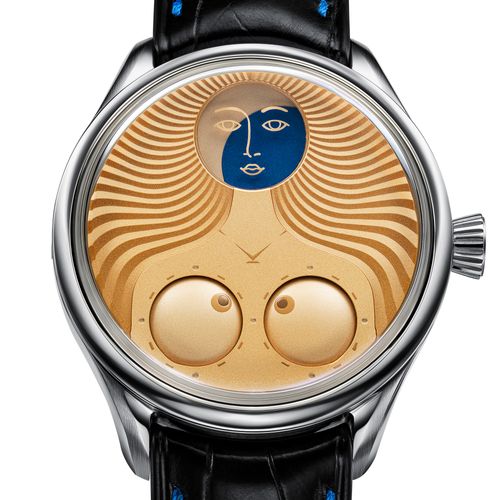
As of today, Venus stands among Konstantin Chaykin’s most compelling mechanical art objects. In this model, the master draws on his most recognizable artistic signature—anthropomorphic time display—yet elevates it into a new, far more intricate artistic dimension. By turning to Botticelli’s The Birth of Venus, Chaykin is able to speak of femininity without overt provocation. In the painting, the goddess appears nude, yet her nudity carries neither a mundane nor an explicitly sensual character: it is a metaphorical birth of beauty, a hymn to natural perfection and divine harmony. Venus modestly covers her breast—and in Chaykin’s interpretation, this gesture becomes, for the first time in the history of watchmaking, a functional element of the mechanism.
The goddess’s face, meanwhile, is rendered in a Picasso-like spirit: its features are traced in a few fine lines on the inner surface of the sapphire crystal, so that they seem to “hover” above the dial. Wavy locks of hair are conveyed through a raised guilloché pattern that simultaneously echoes the surface of the shell in Botticelli’s celebrated composition. The figure’s only adornment is the manufacture’s emblem, placed as a pendant at the neck. The feminine silhouette fills the entire dial, finished in an orange-pink lacquer laid over an abrasive-blasted base.
An enlarged moonphase display becomes the goddess’s visage: as the moon’s shadow, tinted a deep blue, travels across it, her expression appears to soften and subtly change. To achieve this effect, the astronomical module was recalculated so that the disc completes one full rotation in 29.5 days. In high watchmaking, the human face has most often been brought to the dial by the hand of an enameller or painter—leaving the portrait, quite literally, forever fixed on a miniature “canvas.” Venus moves beyond that tradition: the image becomes a function, and the very passage of time becomes part of the artistic statement.
Supplied by the brand to the GPHG for its entry.